Tuesday, May 21, 2013

Moroccan Fun--with Colors!


That's me on the lead camel!

Moroccan Fun--with Colors!
By Victoria Challancin

I'm home!  After almost a month in Morocco, I am home again.   Dazzled anew by the warm and generous Moroccan people, replete with great food, agog over the richly varied topography, touched by kindnesses too many to mention, in awe over the architectural details and sheer imagination involved in the intertwining of art and design, entranced by the pure beauty of the country and its people, enchanted on so many levels I can barely process them, and awash in extravagant colors...I am home again.  Returned to my family and friends, richer in spirit, humbled by the generosity I encountered, profoundly touched and deeply happy.  Whew!  What a trip!

As many of you know, I lead small groups, cultural rather than culinary, to Morocco each year.  After completing my seventh such journey there as a group leader, I am more dazzled, more respectful, more captivated by the people and the culture of Morocco than ever.  Some of you have been rightly scolding me for not having reported to you sooner, but truly I am home again and ready to share.  Today it is the colors...the food and recipes will follow soon!

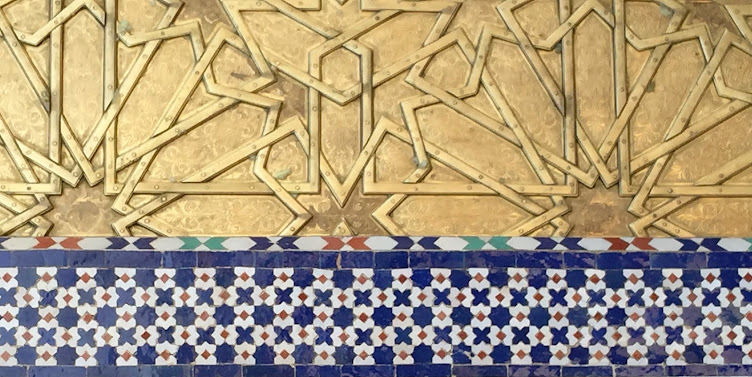
The Colors of Morocco:


Some Interesting Facts about Morocco:
When I first meet with my group, I try to sum up a few facts about Morocco that are crucial to any understanding of it as a place or a culture:  it is NOT the Middle East; it is essentially Berber rather than Arab (and I mean this in no was as a criticism of the Middle East, which is dear to my heart and my personal development, as most of you already know); it is vast and varied; couscous and tagines are not the same thing; and finally, couscous is not a grain, but is a pasta instead...with these in mind, here are a few more facts on Morocco.
  • Mint tea, often called "Berber whiskey," is the national drink of Morocco and is made with fresh mint and green tea; making proper mint tea in Morocco is considered an art form of which the people are justifiably proud
  • Moroccan food is spicy, but not particularly hot
  • Morocco uses many imported spices, but also grows its own saffron, oranges, lemons, mint, olives (and thus, olive oil) and dates
  • Moroccan food is a fusion of Arab, European (French and Spanish), and African influences
  • On Friday, most people/families eat couscous, the main Moroccan Berber dish which existed long before the arrival of the Arabs
  • Couscous is a pasta made from semolina--it is not a grain
  • The most common spices used in Moroccan cooking are:  cumin (kamoun), turmeric (kharkoum), ginger (skingbir), paprika (tahmira), anis seed, cinnamon (karfa), sesame seed, coriander (kasbourqesbouror  ),  parsley (maadnous), saffron (zaafrane), mint, and pepper (libzar)
  • The main meal is usually eaten at midday (except during Ramadan and some feast days)
  • Bread is eaten with every meal
  • Salads can be hot or cold, cooked or raw
  • Meals typically start with a series of hot and cold vegetable salads, followed by a tagine of lamb, chicken, or vegetables, followed by couscous topped with meats, vegetables, and a broth/sauce
  • At the end of a meal, mint tea is often served
  • Lamb is the most common meat consumed in Morocco
  • Chicken and turkey are also commonly eaten
  • Although sweets are common in Morocco (often served with tea), they are not necessarily served at the end of a meal;  seasonal fruits, especially orange slices with cinnamon and a sprinkle of sugar, however, are commonly served to finish a meal
  • Morocco's official name is "The Kingdom of Morocco"
  • In Arabic, Morocco's name is "Al-Mamlaka al Maghribiya," which translates as "The Western Kingdom"  ("al Maghreb" means "the West")
  • The term "Berber" can be pejorative, depending on how it is used; most Berbers prefer to be called "Amazigh"
  • Kissing on the cheek is a common way of greeting among Moroccans; the closer your relationship, the more kisses
  • Morocco was the first country to recognize the United States as an independent country
  • Morocco has about 32 million people and is around the size of Canada or slightly smaller that the state of California
  • Although Morocco is an Islamic country, it follows the Gregorian calendar where Saturday and Sunday are the weekend, but uses the Muslim calendar for religious purposes
  • 99% of the population of Morocco is Muslim, with Christian and Jews making up the rest
  • Morocco is the second largest producers of roses in the world
  • The oldest continuously functioning university in the world is the University of Al-Karourine in Fès, which was established in 859 A.D by a woman
  • Morocco gained independence from France in 1956
  • The Phoenicians, Carthaginians, and Romans all had a presence in Morocco and there are even many stone circles which dot the country and prove there was contact with the megalithic cultures of Europe
  • Rabat is the capital of Morocco, though Casablanca is its largest city
  • Morocco is a monarchy with a parliament and an independent judiciary (i.e. a constitutional monarchy)
  • Morocco, the 12th richest country in Africa, is divided into 16 regions made up of 62 provinces
  • Morocco is the only African country in Africa which does not belong to the African Union
  • Morocco is a member, however, of the Arab League
  • Morocco is also a major non-NATO ally of the United States
  • Morocco has four ancient imperial cities:  Marrakech, Fès, Meknés, and Rabat
  • Although nearly all Moroccans are Arab or Berber, Arabic is the official language (though many speak Berber)
  • The Moroccan Berber language consists of three main Amazigh dialects, Tarifit, Tashelhit, and Tamazight
  • Spanish is also spoken widely in the north of the country
  • The Arabs brought Islam, along with the Arabic language and elements of culture to the Maghreb during the Muslim conquests of the 7th century
  • French is also widely spoken
  • The official language may be classical Arabic, but Morocco has a distinctive dialect of its own, called Derija
  • The trade routes that criss-crossed Morocco dealt principally in salt, gold, slaves, ostrich feathers, precious wood, spices and more
  • 99% of the Muslims in Morocco are Sunni
  • Berbers are identified mainly by language, but also by customs and culture
  • In Morocco, about 40% acknowledge a Berber identity, though many more have mixed Arab-Berber ancestry
Parting Shot:
That's still me...on the lead camel, taking the photo

Please do not use photos or text without permission.  Thanks!


Wednesday, May 8, 2013

Watercress, Mizuna, and Grapefruit Salad with Curry Vinaigrette

Watercress, Mizuna, and Grapefruit Salad with Curry Vinaigrette

Watercress, Mizuna, and Grapefruit Salad with Curry Vinaigrette
by Victoria Challancin

Before I made this salad, I can honestly say that I never thought to add curry powder to a vinaigrette.  Somehow it just sounds wrong.  But how off was I on this one.  This salad is a delight!  The tartness of the grapefruit, the sweetness of the dates, the peppery taste of the cress and mizuna, and the complexity of the curry flavors make this such an interesting dish.  


Recipe:  Watercress, Mizuna, and Grapefruit Salad with Curry Vinaigrette
(Recipe from myrecipes.com, Cooking Light)

4 cups trimmed watercress
4 cups torn frisée (about 1 head)
1 cup red grapefruit secionts (about 2 grapefruits)
1 cup thinly sliced red onion
8 whole pitted dates, sliced
2 tablespoons white balsamic vinegar
1/2 teaspoon good quality curry powder
1/2 teaspoon salt
5 teaspoons grapeseed oil

Arrange watercress and frisée on a large platter, and top evenly with grapefruit, onion, and dates.

Combine vinegar, curry powder, and salt in a small bowl, and slowly add oil, stirring constantly with a whisk.  Drizzle over salad.  Serve immediately.

Parting Shot:

A local cafe...

©Victoria Challancin.  All Rights Reserved.

Like life and love, recipes are meant to be shared, but please ask permission before using photos and text.  Thanks!


Tuesday, April 30, 2013

Comforting Chicken Pot Pie Soup


Comforting Chicken Pot Pie Soup
by Victoria Challancin


I am a sucker for a good chicken pot pie.  A good one makes me go weak at the knees.  Need I admit that this is an embarrassing confession?  But really, what's not to love?  The flavors are soothing, the idea of it is comforting, and it reminds my of my childhood in the most pleasant way.  

This soup has all the trappings of a good chicken pot pie, but without the crust.  Although this was an experiment, I will definitely make it again and when I do, I'll add a splash of good sherry and make some cut-out puff pastry stars to bake and float on top.  Then it will be perfect--though this worked for me just as it is.


Cook's Notes:  Although I made a really rich homemade chicken stock, I used a rotisserie chicken for the actual meat.  Go figure.  I also completely forgot the parsley, which was chopped and waiting!

Recipe:  Chicken Pot Pie Soup
(Recipe by Victoria Challancin)

2 tablespoons butter
1 1/2 cups diced leek or 1 large onion
1 garlic clove, minced
1/4 cup flour
2 cups whole milk
3 large celery stalks, chopped
2 large carrots, diced small
2 medium potatoes or10 to 12 small red potatoes, cubed
8 oz sliced cremini mushrooms
6 cups chicken broth, preferably homemade
2 cups milk
1 lb cooked chicken (rotisserie is fine), in small cubes or shredded
1 cup frozen peas
Kosher salt and freshly ground black pepper, to taste
1 teaspoon Italian seasoning or poultry seasoning 
2 tablespoons chopped parsley (optional)

In a large pot melt butter.  Add leek or onion and garlic.  Cook, stirring, until soft, about 5 minutes.  Sprinkle with flour and cook for 1 minute.  Slowly add milk and cook until thick.

Put the celery, carrots, potatoes, mushrooms, and broth in a separate pot.  Bring to a boil.  Partially cover and simmer on low, until the vegetables are soft, approximately 20 minutes.  Add milk and leek mixture.  Season to taste with salt, pepper, and Italian seasoning or poultry seasoning.  Add the chicken and peas.  Cook and additional 2 to 3 minutes or until the soup thickens and is hot.  Adjust seasoning to taste.  Sprinkle with chopped parsley and serve.

Note:  If you prefer this soup really thick, make a slurry by whisking 2 tablespoons flour with 4 tablespoons cold water.  Add and cook until desired thickness is achieved, checking to make sure you don't have a raw flour taste.  If you do, simply cook the soup a bit longer.

Parting Shot:  (Yes, I've had this in a draft for a while!)


©Victoria Challancin.  All Rights Reserved.

Like life and love, recipes are meant to be shared, but please ask permission before using photos or text.  Thanks!


Tuesday, April 23, 2013

Beet Slaw with Tahini-Ginger Dressing


Beet Slaw with Tahini-Ginger Dressing
by Victoria Challancin

Have I mentioned that I could probably eat cardboard if it were smeared with tahini?  Add a fig and it would be a done deal.  Luckily, I don't have to ingest paper; I can just add tahini to everything imaginable in my kitchen.

This salad is a gem I created for dinner with just a few ingredients I had on hand.  Healthy and laden with flavor, it would work any time of year.  Plus, like most salad recipes, this one is flexible.  I would love apple and jícama with it (does this sound reminiscent of the salad recipe I posted recently which includes both?) as well as bell pepper.  And of course, the dressing would work on any salad or as a dip for crudités, especially raw brocolli and cauliflower.  Thinly sliced cabbage, purple and green, would really make this a slaw.  And radishes?  Why not?  No cardboard necessary.


Recipe:  Beet Slaw with Tahini-Ginger Dressing
(Recipe by Victoria Challancin)

For the Salad:
1 1/2 cups grated raw beets
1 1/2 cups grated carrots
3 tablespoons mint chiffonade
1 small red onion, thinly sliced

For the Dressing:
3/4 cup tahini
1/2 cup warm water
Juice of 1 lemon or 2 small limes
2 teaspoons ginger juice, from squeezed grated ginger
3 tablespoons honey
Sea salt and black pepper to taste

Place the salad ingredients in a bowl.

In another medium bowl, whisk the tahini with the warm water until thoroughly mixed, with no lumps.  Add the remaining ingredients and whisk again.  Pour desired amount over the salad ingredients and toss to mix well.


Parting Shot:  Mexican Humor

©Victoria Challancin.  All Rights Reserved.

Like love and life, recipes are meant to be shared, but please ask permission before using text or photos.  Thanks!


Tuesday, April 16, 2013

A Truly Unusual Salad--with Graffiti!


Jícama, Carrot, and Apple Salad with Lime-Vanilla Dressing

A Truly Unusual Salad--with Graffiti!
by Victoria Challancin

I've been madly busy trying to prepare for a major trip which will take me to Paris and to Morocco, where I will lead my seventh trip to that incredible country, which somehow manages to be  a marvelous haven of peace and excitement at the same time.  And if you want to discover just why I love Morocco so much, just click here.  Maybe I'll entice you to join me next time!

Of course many of my friends are like me in that they love any excuse to celebrate--and thanks to them, I have celebrated a lot of late.  Last Saturday two good friends took me out to lunch, where, in addition to a greatly over-priced but comforting chicken pot pie, I enjoyed the most refreshing and unusual salad I have had in yeas:  grated jícama, carrot, and green apple with a hint of cilantro for color, tossed with lime juice and vanilla.  The vanilla is soft, yet haunting, offering just enough interest to evoke the question, "What am I tasting?"  A truly inspired marriage of ingredients.

As soon as I got home, I knew I had to make it, and I did.  Perfect!  And a hit.  Don't let this unique combination of ingredients put you off.  Truly, you need to just embrace this and give it a whirl.

Cook's Notes:  This salad couldn't be simpler.  If you don't have access to jícama, use grated raw beets instead.  No agave nectar?  Substitute honey.  Remember that the taste of the dressing is very subtle, so add the vanilla drop by drop.  I don't think the original salad had any sweetener either, but I thought that just a touch of agave nectar would cut the tartness a bit.  Of course, you just need to play with this as I did to make it suit your taste.  I was told in the restaurant the dressing had lime juice, which makes it very Mexican, but as I had a yellow lemon, I used that instead.  The original salad also had its veggies julienned, but I have a grater that worked faster.

Jícama, Carrot, and Apple Salad with Lime-Vanilla Dressing
(Recipe by Victoria Challancin)

1 cup grated jícama (or raw beets)
1 cup grated carrot
1 cup grated peeled green apple
1 to 2 tablespoons roughly chopped cilantro
3 to 4 drops of pure vanilla extract
1/2 to 1 teaspoon agave nectar or honey
The juice of one lemon or lime (use two limes if small)

Place the jícama, carrot and apple in a bowl with the cilantro, adding the apple last in order to retain its colo.  In a small bowl, mix the lemon juice, vanilla, and agave nectar, adjusting ingredients according to taste.


A freshly graffitied wall celebrating the importance of corn in Mexican culture

Graffiti in San Miguel

Hip, edgy, modern.  All words that describe the San Miguel de Allende of today, which is a far cry from the sleepy, colonial, artist's colony I moved to almost twenty six years ago.  And while San Miguel may be hip, edgy, and modern, I certainly am not.  Oh so clearly not, as was proved when I visited a recent event that featured graffiti artists who gathered from all over Mexico to participate in the rather joyous painting of buildings in one of San Miguel's most popular neighborhoods, or barios.  

While I loved the idea of the event and the enthusiasm that accompanied it, unfortunately I didn't love most of the graffiti, which only proved to me that no matter what my own mental image of myself is, I am clearly not hip, edgy, and modern enough to appreciate this interpretation of modern Mexican life.  Or not all of it.  If you take away the giant vulture, the strange dragon, and what looks to me like Japanese cartoon characters, some of what remained was terrific.  Scroll down and tell me what you think.

A close up of the corn itself

A rather odd sea creature on the side of my favorite tiny grocery store,which I featured here in a post on a Mexican Green Grocer

Mother with child wrapped in a rebozo, or shawl, handing an offering
What started out as a rather nice jaguar...

but turned into this  (and this from one who loves skeletons)

Don't even ask me what this is...I have no idea, but wish fervently that I didn't have to see it each time I visit my grocer

The hand of the mother with child, offering a rose to the patron saint of Mexico, the Virgin of Guadalupe

On the wall of a mechanic's shop

Be happy I cut of the giant vulture's head


More images

Even the roughest-hewn wall got some color,this time with birds,including the beloved colibrí, or hummingbird


Some Fun Facts about Graffiti:

  • The modern word graffiti comes from the Italian; the singular form is graffito which in turn comes from the Greek word graphien, which means "to write"
  • Graffiti has existed from ancient times (I clearly remember my first encounter with really interesting graffiti in Pompei--interesting and some of it quite daring and naughty, as a friend recently reminded me)
  • Graffiti was recorded as long ago as five thousand years in cave and rock petroglyphs
  • Graffiti was frequently found on Roman architecture (Who could forget the incredible opening of the wriggling graffiti in the BBC mini series "Rome"?)
  • Graffiti performers are called "street writers" or simply "writers
  • Street writers also have their own individual "tags," or signatures that single out their work as unique
  • Spray paint is the most common tool of today's graffiti artists
  • Graffiti can be everything from simple scratch marks to elaborate murals
  • Often political in nature, graffiti can also be intended to send messages, sometimes gang-related
  • In most countries, graffiti is considered to be vandalism and is punishable by law
  • In some cities, graffiti is considered an art form worthy of books and galleries
  • Connected to pop culture (and why I am feeling so clearly "unhip), graffiti reflects popular culture and interprets current cultural trends
  • Two types of graffiti have evolved in today's world:  the "bombers," who simply want to mark as much space as they can with little thought to style, imagination, or art and the "street writers" mentioned above, who create works of unique art
  • The colst of graffiti to the London economy alone exceeds 100m pounds annually


Parting Shot:
And finally, a painting I can wrap myself around

©Victoria Challancin.  All Rights Reserved'

Please do share the recipes, but ask permission before using text or photos.  Thanks!


Saturday, April 6, 2013

Smoked Trout Blinis with Crème Fraîche and Dill


Smoked Trout Blinis with Crème Fraîche and Dill

Smoked Trout Blinis with Crème Fraîche and Dill
by Victoria Challancin

These tasty morsels couldn't be easier to make.  Tiny pancakes, smoked trout, a dollop of crème fraîche, and a sprig of dill.  How simple it that?  Of course, the perfectionist in me longed for buckwheat flour and my dear Swedish friend, Berit, who loved them, added that a bit of horseradish wouldn't go amiss--but other than that, these hors d'oeuvres, which disappeared quickly, were a hit.
Smoked Trout Blinis with Crème Fraîche and Dill


A Little History of Blinis

The website RussiaPedia.rt.com provides us with a fascinating history of blini, those popular thin pancakes beloved in Russian zakuski, apparently celebrated their 1000th anniversary recently.  Deriving from its ancestor that was made from oat jelly, when a distracted and hungry traveler left his oat jelly too long over the fire, thus creating the first blin.  OK.  Maybe.  But I am willing to give the Russians credit for this and why not?  It is as reasonable as other culinary claims that just might not be able to be substantiated today.

In pagan times blini were made by early Slavic peoples as a part of a celebration known as Maslenitsa, which was also called "Butter Week, Pancake Week, and Cheese Fare Week," as a part of a sun festival which celebrated the welcome end of winter and the coming of spring.  Round and golden, blini symbolized the sun itself. Legend has it that if a woman prepared delicious pancakes during this week, then spring and summer would bring rich harvests, good health, and success.  

The Orthodox church adopted this tradition, which is carried on to the present day.  Jewish immigrants to the United States also popularized the tradition with their blintz, which are now known all over the U.S., not just in New York.

Blini in Russia featured in rituals throughout the lives of every individual.  Given to women after childbirth to bring luck to the newborn, celebrated as a part of the annual sun festival, and provided at funeral feasts, blini take on symbolic meaning in the lives of everyday people and the rich as well.  During Lent in Lithuania, blini or blintzes are a traditional meal.

Like pancakes everywhere, blini can be eaten with countless fillings or toppings:  mushrooms, meats, fruits, sour cream, onions and potatoes, fish, honey, jams, caviar, various cheeses, and more.  The batter itself can be made from from from all kinds of flour, with our without yeast.  Various additions to the batter could be potato or apple and raisins.  

According to russiapedia, many traditions are associated with blini:  the first pancakes, usually the poorest in form and texture, were set on windowsills for the poor.  Special races were held in ancient Russia as well, where people had to run while jolting blini high into the air from the handleless, cast-iron griddle used to make them.  Russian writers, including Chekhov, Pushkin, and Gogol have written about them and even have dedicated stories to them.

Beloved throughout history, blini still are beloved in Russia. And lucky for most of us, all over the world in one form or another.

Smoked Trout Blinis with Crème Fraîche and Dill

Cook's Notes:  As I mentioned above, I would have loved to have made these with buckwheat flour, but don't have it available to me here in San Miguel.  Yet.  I also would probably take Berit's advice and add a bit of horseradish.  Capers and radishes could also figure into the sour cream itself, or the topping.  Because Mexican crema ácida, or sour cream, is so similar to the French crème fraîche, of course I used that.  For the trout I used smoked rainbow trout from Costco--delicious.  These were made in a cooking class I taught to Mexican cooks, who giggled throughout the making of them at how our pancakes bore little resemblance to a round, golden sun!


Recipe:  Smoked Trout Blinis with Crème Fraîche and Dill
(Recipe from Saveur Magazine)
Makes about 30 blinis

2 eggs
1/2 cup sour cream
1/4 cup flour
1/2 teaspoon kosher salt
1/8 teaspoon baking soda
1 tablespoon canola oil
1/4 lb boneless smoked trout, flaked into 12/-inch chunks
Crème Fraîche (or Mexican sour cream), cayenne pepper or paprika, and fresh dill sprigs, for garnish

Whisk eggs in a bowl, then whisk in sour cream; set aside.  In another bowl, whisk flour, salt, and baking soda.  Add dry ingredients to egg mixture; whisk until smooth.

Heat a 12-inch nonstick skillet over medium heat; brush lightly with oil.  Working in batches, spoon 1 tablespoon amounts batter into pan (Note:  I made them a bit smaller) to form 1 1/2- to 2-inch rounds.  Cook, flipping once, until golden, about 2 minutes.  Transfer to serving platter, and repeat with remaining batter.  Top each blini with smoked trout, a dollop of crème fraîche, a sprinkle of cayenne or paprika, and a dill sprig.

Smoked Trout Blinis with Crème Fraîche and Dill

 Parting Shot:  

©Victoria Challancin.  All Rights Reserved.

Recipes are meant to be shared, but my photos and text are always my own.  Please ask permission before using.  Thanks!